A first for sponsorship
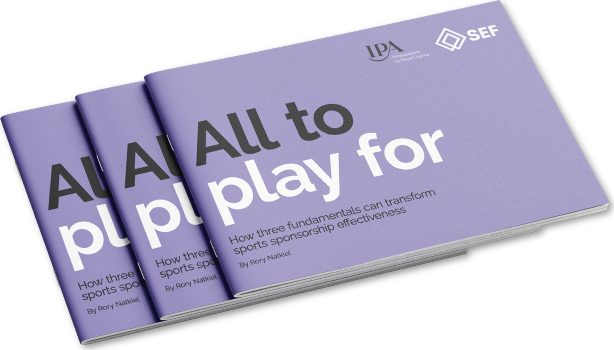
Sports sponsorship is one of the fastest-growing areas of marketing investment, yet it has never had the shared evidence base that advertising takes for granted. All To Play For is our answer. It is the first report on sports sponsorship the IPA has ever published, and the first time the sponsorship sector and the marketing effectiveness community have studied the discipline together.
We set out to answer the question every sponsor, rights holder and agency faces: what separates the partnerships that deliver business results from the rest? The answer is three fundamentals, applied consistently, and a new Sponsorship Effectiveness Model that shows where any partnership sits today and how far it can go.
We unveiled the report at the IPA Effectiveness Conference on 7 October 2026. It draws on a study of 143 brands, agencies and, for the first time, sports rights holders.
Confidence is the opportunity
Four in ten practitioners are confident that sports sponsorship delivers business results such as sales, profit, market share and price elasticity. The figure is broadly the same for brands (45%), rights holders (41%) and agencies (35%). A further 29% are "somewhat confident", so a relatively small shift would change how the whole sector sees its return.
The stakes are rising: the global sports sponsorship market is forecast to reach $181.38bn by 2034.
Three fundamentals
Three practices set the leaders apart:
- setting clear commercial objectives
- measuring commercial impact and using it at renewal
- integrating sponsorship activity with wider brand communications
Practitioners who are confident sponsorship delivers business results are more than twice as likely to have clear commercial objectives (61% against 24%). They are four times as likely to rate their measurement capability as strong (48% against 12%), nearly three times as likely to use econometrics or marketing mix modelling (37% against 13%), and almost twice as likely to report sponsorship that is mostly or fully integrated with wider brand communications (55% against 30%).
Organisations that consistently practise all three are almost six times more likely to be confident their sponsorships deliver business results. Only 17% do.
The measurement gap
82% of respondents set commercial objectives for sponsorship, but fewer than half (47%) use measurement tools capable of showing whether those objectives were met.
Most treat data as an end-of-deal activity. 70% use effectiveness data for post-campaign reporting, 39% use it to set objectives, and 22% use it to optimise activity while a programme is live. 43% say industry-wide measurement standards and a common currency would make the biggest positive difference to sponsorship effectiveness.
The Sponsorship Effectiveness Model
The report introduces a six-stage framework for assessing how a sponsorship works for a brand and where it can go further:
- Inventory Buy
- Rights Activation
- Creative Platform
- Distinctive Asset
- Category Advantage
- Brand Narrative
The step change comes at Stage 3, Creative Platform, where a sponsorship is built around a consistent creative idea rather than activation of the rights alone. From that stage on, confidence in business results rises from 28% to 47%, clear commercial objectives from 21% to 55%, and integration with wider communications from 19% to 58%.
"The Sponsorship Effectiveness Model is intuitive and easy enough to understand that anybody working in sponsorship can use it." Claire Humphris, CMO, British Cycling
Get the report
All To Play For is written by our chair, Rory Natkiel, and published with the IPA. It is free to download from the IPA website for members and non-members; you'll need to sign in or create a free IPA account.